
Program Overview
This video explains how the To Write Art programs work, from choosing a program on the website through to completing the final stages of the course. It outlines what to expect before and after purchase, and how the digital programs are accessed and used.
The video also introduces the structure of the program, including topics, mind maps, written theory, practical art tasks, reflection, and self-evaluation. By watching this overview, you will gain a clear understanding of how the program is designed to support independent thinking, creative growth, and meaningful engagement with art.
Our Programs
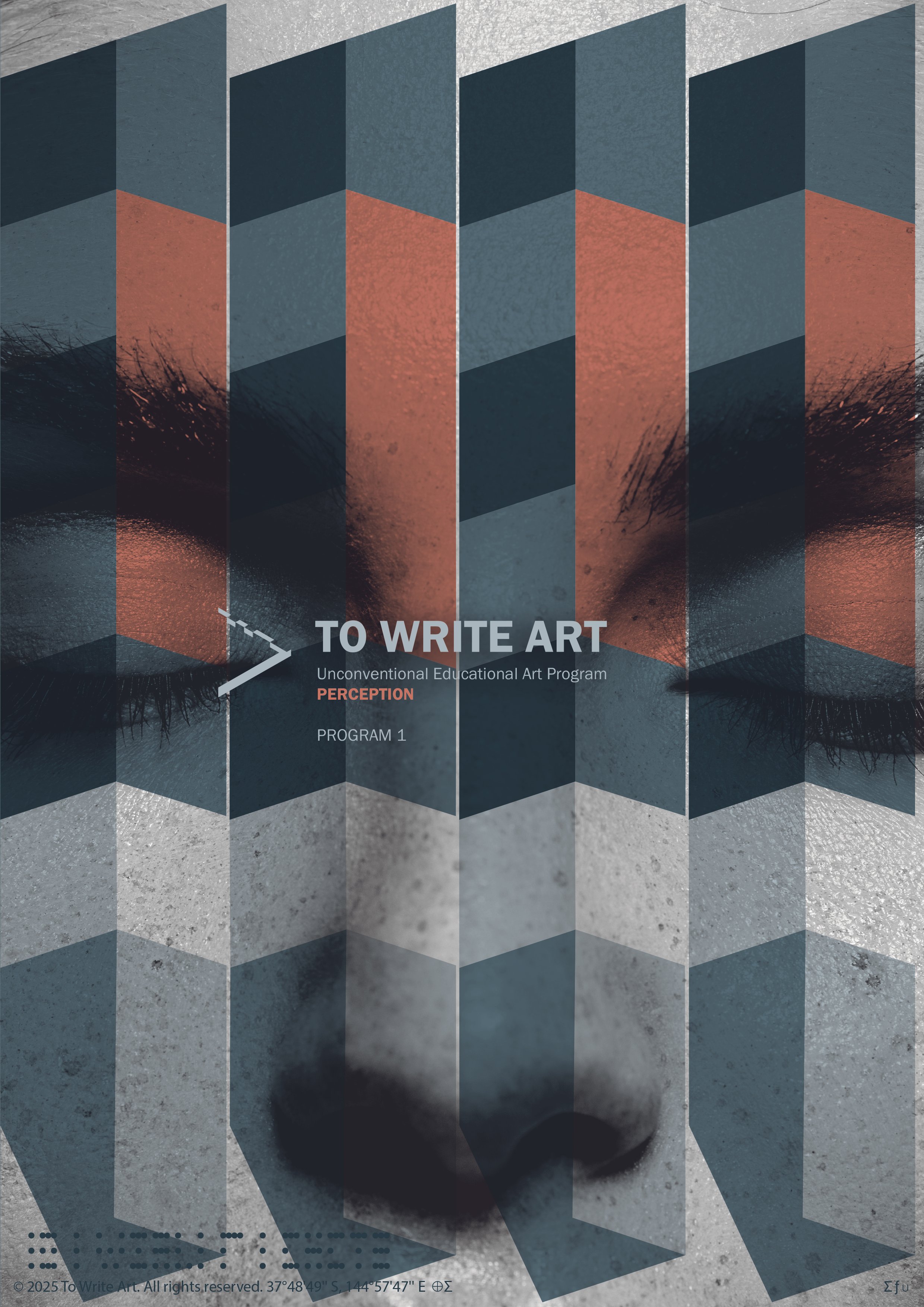
Program 1 — Perception | 202-page PDF download
To Write Art — Perception is a 12-month, self-directed art education program built around philosophical and conceptual written content that explores how perception, emotions, and personal reflection shape creativity and artistic expression.
Program Overview
This program invites students to investigate how perception influences creativity — examining how emotions, sensory experiences, cultural context, and imagination transform the act of seeing into art. It's designed for mature art students with basic art knowledge who are ready to engage with complex emotional and philosophical aspects of art.
Seven Core Topics (12 Tasks Total)
Seeing & Feeling Art (Months 1–2)
Tasks: Childhood Memory artwork & Personal Reflection painting
Focus: How personal perception differs between individuals
Something vs. Nothing (Months 3–4)
Tasks: Drawing a Wish & Representing ‘Nothing’
Focus: Exploring presence and absence, emotion and emptiness
Bad Art (Month 5)
Task: Creating art around ‘Failure’
Focus: Embracing experimentation and viewing mistakes as growth
Colour (Months 6–7)
Tasks: Using one primary colour & Removing that colour
Focus: Colour psychology and emotional communication
Sound (Months 8–9)
Tasks: Sound for Art & Engaging All Senses
Focus: Integrating sound with visual art and multi-sensory creation
More Than Art (Month 10)
Task: Self-Portrait
Focus: Representing personal identity and neurodiverse perspectives
To Do Art (Months 11–12)
Tasks: The Art of Now & Future of Art
Focus: Self-reflection and imagining art's future possibilities
Key Features
Flexible pacing (3–4 weeks per task recommended)
Freedom to choose any artistic medium (traditional or digital)
Structured components for each topic: Mind Maps, Learning Objectives, Reflective Processes, Hints, and Self-Evaluation
Optional artwork submission for Certificate of Completion
Opportunity to share work globally and compare approaches across cultures
Program Goals
Expand creativity by challenging how you see and interpret art
Enhance personal growth through exploring perception, emotion, and imagination
Understand art as both an emotional and intellectual experience
Create a body of work that captures not just what you see, but how you see
The program emphasises that by its end, students will have developed the ability to observe, reflect, and express in unconventional ways, creating art that transforms perception into meaningful expression.
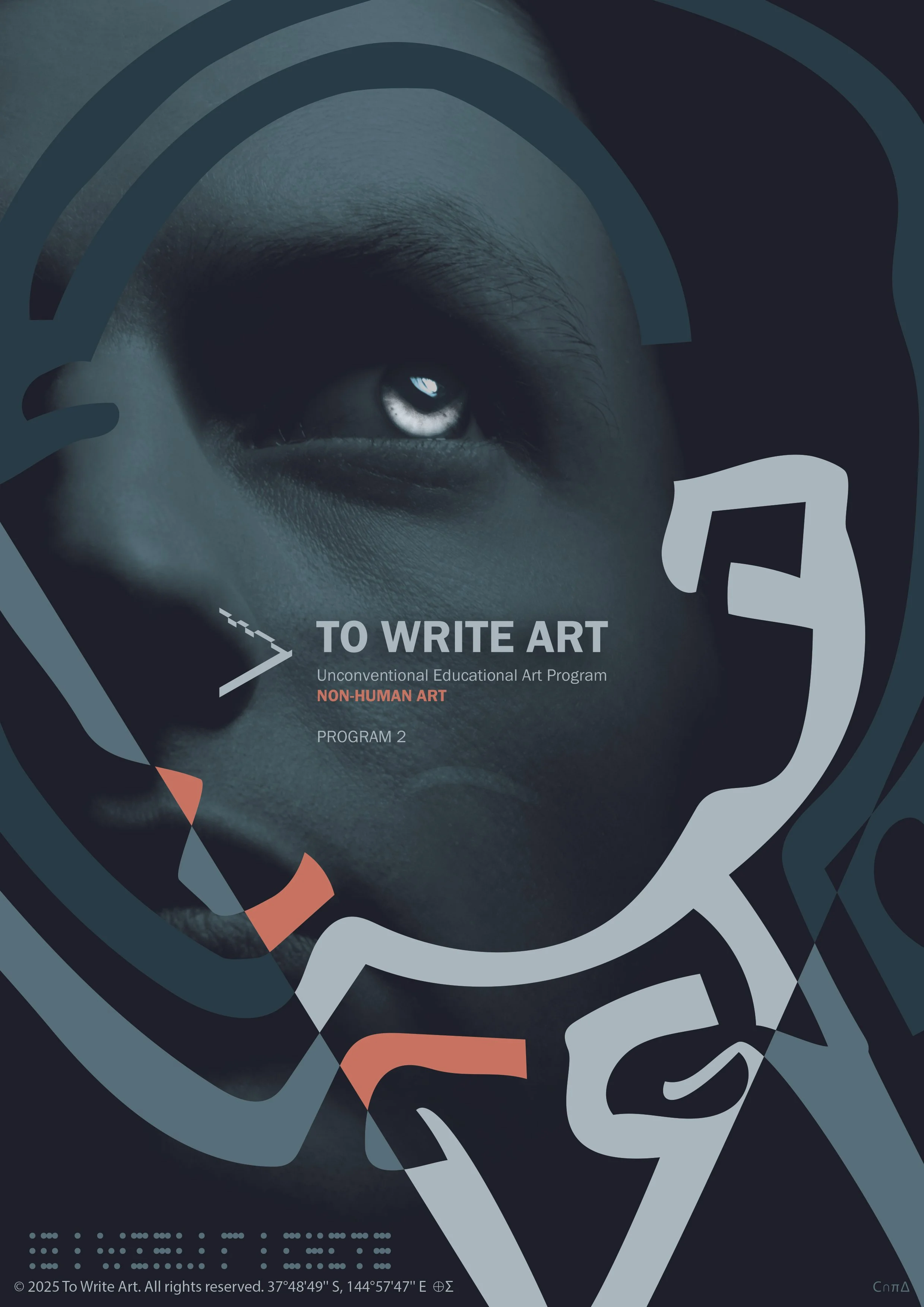
Program 2 — Non-Human Art | 202-page PDF download
To Write Art — Non-Human Art is a 12-month, self-directed art education program built around philosophical and conceptual written content that explores creativity beyond human boundaries, examining how non-human forces can shape, inspire, and collaborate in the artistic process.
Program Overview
This program invites students to step beyond traditional boundaries and engage with the natural world, non-human life forms, technology, energy, and mystery. It's designed for mature art students with basic art knowledge who are curious, imaginative, and comfortable with open-ended creative challenges and abstract, conceptual work.
Six Core Topics (10 Tasks Total)
Not Human (Months 1-3)
Tasks: Insect-Inspired 3D Art, Peacock-Inspired Performance Art & Organism-Inspired Art
Focus: How non-human entities like insects, animals, and aquatic organisms create art and inspire human creativity
Cosmic Art (Months 4-5)
Tasks: Zodiac-Inspired Portrait & Painting of Planetary Influence
Focus: How astrology influences art, with zodiac signs and planets shaping creativity
Spiritual Art (Months 6-7)
Task: Living and Spiritual Connection
Focus: Exploring profound beliefs and connections through sacred objects and spiritual themes
The Movement of Air (Months 8-9)
Tasks: Kinetic or Sound Art & Four-Dimensional Art
Focus: How air's intangible nature adds movement, depth, and interactivity across dimensions
Artificial Intelligence (Month 10)
Task: AI-Enhanced Memory Art
Focus: AI's role in art and its potential to complement or challenge human creativity
The Unexplained (Months 11-12)
Task: Alien or Paranormal Art
Focus: Exploring supernatural or extraterrestrial phenomena and unexplained artistic influences
Key Features
Flexible pacing (4-5 weeks per task recommended)
Freedom to choose any artistic medium (traditional, digital, found objects, or experimental materials)
Structured components for each topic: Mind Maps, Learning Objectives, Reflective Processes, Hints, and Self-Evaluation
Optional artwork submission for Certificate of Completion
Opportunity to share work globally and compare approaches across cultures
Program Goals
Expand creativity by opening practice to unexpected influences from natural factors, unexplained phenomena, and technology
Enhance personal growth by letting go of fixed expectations and embracing the unfamiliar
Understand art in a new way by discovering how creativity can emerge from patterns, systems, and interactions beyond human invention
Create a body of work that embodies collaboration with the non-human
The program emphasises that by its end, students will have developed a more resilient, imaginative, and open artistic practice — questioning authorship, exploring collaboration with forces beyond the human, and discovering art shaped by imagination, curiosity, and openness to the unknown.
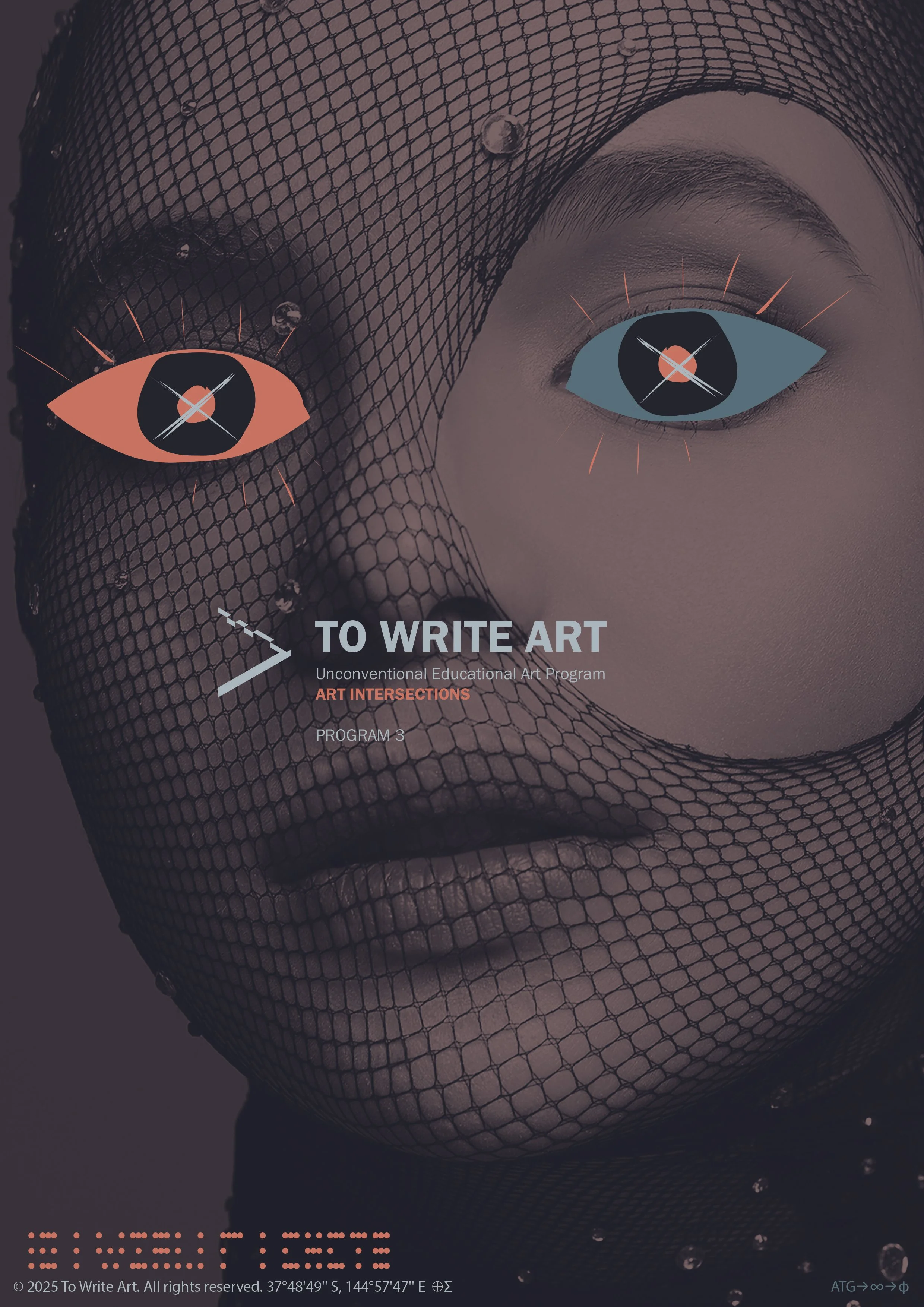
Program 3 — Art Intersections | 216-page PDF download
To Write Art — Art Intersections is a 12-month, self-directed art education program built around philosophical and conceptual written content that explores how creativity operates at the crossroads of ideas, systems, and hidden structures, examining how art communicates, encodes, and transforms meaning.
Program Overview
This program invites students to investigate how art reveals, disguises, and transforms meaning through puzzles, games, hidden messages, numbers, problem-solving, time, and codes. It's designed for mature art students with basic art knowledge who enjoy problem-solving, symbolic thinking, or reflective work and are ready to explore complex ideas and deeply engaging tasks.
Seven Core Topics (12 Tasks Total)
Forbidden Art (Month 1)
Task: The Forbidden Act (ethically and legally explored)
Focus: Transforming forbidden topics into meaningful visual messages that inspire reflection and positive social change
The Puzzle (Months 2-3)
Tasks: Puzzle Within a Puzzle & Your Puzzle
Focus: Embedding puzzle elements within art to create interactive, problem-solving experiences
The Game of Art (Month 4)
Task: The Card Game
Focus: Combining elements of art and gaming to create interactive artworks with narrative and audience participation
Art by Numbers (Months 5-6)
Tasks: Numerology & Your Number
Focus: Integrating numerological meanings and symbolic systems into artwork
To Problem-Solve (Months 7-8)
Tasks: Problem-Solving & Holiday Art
Focus: Using art as a tool for visualising problem-solving processes and overcoming challenges
Time (Months 9-10)
Tasks: A Time Lesson & Time Challenge
Focus: Incorporating time as a medium and exploring how time constraints influence creativity
The Code (Months 11-12)
Tasks: Your Code & The Location
Focus: Using coding systems to embed hidden messages and invite viewers to decode meaning
Key Features
Flexible pacing (3-4 weeks per task recommended)
Freedom to choose any artistic medium (traditional or experimental)
Structured components for each topic: Mind Maps, Learning Objectives, Reflective Processes, Hints, and Self-Evaluation
Optional artwork submission for Certificate of Completion
Opportunity to share work globally and compare approaches across cultures
Strong emphasis on ethics, responsibility, and interdisciplinary learning
Program Goals
Expand creativity by exploring how art interacts with rules, secrets, logic, play, and the unknown
Enhance personal growth by reflecting on ethical boundaries, emotional experiences, and symbolic systems
Understand art in a new way by discovering how it can function as code, a mirror of social behaviour, storytelling method, and puzzle to solve
Create a body of work that demonstrates symbolic, critical, and reflective thinking
The program emphasises that by its end, students will have developed the ability to think differently — approaching art as a layered system of discovery, challenge, and transformation. The journey produces work that shows not only what you can make, but how you can think, question, and re-imagine through art.